Now gluten-free!

Sunday, December 31, 2006

Demotivators

I really enjoy the "demotivational" posters at "Despair.com". I'd love to wallpaper my office with them, but, as a low-level manager, I'm not supposed to be cynical about the workplace anymore. At least, I'm not supposed to be overtly cynical about the workplace. Maybe I'll just get some small prints that the upper-level managers can't read from where they stand. :)


Friday, December 29, 2006

"Everybody Must Get Stoned!"

If you've ever wondered what it's like to have a kidney stone attack, imagine someone stabbing you in the back with a dull, jagged knife and twisting it and you'll begin to have some idea. All I can say is, "Thank goodness for morphine."

This morning, I ran across this article on Forbes.com:
    More U.S. Kids Developing Kidney Stones

    Kidney stones are becoming increasingly common in children, according to pediatricians at Johns Hopkins Children's Center in Baltimore.

    "More and more children with kidney stones are coming to us," said kidney specialist Dr. Alicia Neu, co-director of the kidney stone clinic at the Children's Center, in a prepared statement. "While this is somewhat unexpected, it is not totally surprising given that so many other conditions are on the rise in children due to poor diet, such as high blood pressure, type 2 diabetes, and obesity to name a few," she said.

    Pediatricians believe that the main culprits of the increasing trend of kidney stones in children are probably too much salt and too little drinking water.

    The best ways to prevent the most common types of kidney stones or slow their growth is to limit salt in the diet and drink plenty of water.
Naturally, I sympathize with these kids. It's one thing to get kidney stones when you're in your 30s. That can be hereditary. But kids shouldn't be getting them. I'm no health nut - and I'm certainly no doctor - but I think much of it is due to children being fed what their parents see as "healthy" food.

For example, instead of allowing little Jimmy to drink Coke for his daily caffeine boost before school, Mom gives him Diet Coke. The problem is that while regular Coke is high in sugar, the zero-calorie alternative contains toxic artificial sweeteners and much higher levels of sodium. A healthier choice? I think not.

Another culprit may be soy. Now, soy is supposed to be healthy, right? Well, based on what I've read, non-fermented soy should be avoided. That includes tofu, most vegetable oils, and, of course, soy milk. Research has shown that soy-based foods contain oxalate, "a compound that can bind with calcium in the kidney to form kidney stones."

Take it from someone who's been "stoned" twice: it's something you want to avoid if you can help it. So, be careful out there, okay?

Thursday, December 28, 2006

Give Me a Sign

Those of us who have been entrusted with a license to operate a motor vehicle on our nation's roadways know the freedom and independence that go along with that. But we also know - all too well - the accompanying frustration and danger: dodging idiots who think they own the road, dealing with frightened drivers who have no idea how to merge, getting stuck behind someone with the neurological disorder that makes them subtract 25 from every speed limit sign, or just having to sit in rush hour traffic without your iPod. (I'm still trying to figure out why it's called "rush hour," but that's another issue altogether.)

One of the biggest concerns drivers face is paying attention to all those annoying traffic signs. How can we be expected to deal with all the normal distractions of driving while at the same time having to read each and every little sign thrown at us? Could it be that they do more harm than good? From a recent Boston Globe article:
    Picture yourself on a typical morning commute. You start out with a few suburban streets, then some arterial roads, a few miles of open interstate, and finish off with a nice refreshing bumper to bumper crawl to the office.

    Let's say the trip takes you about half an hour, and you cover about 10 miles. During that time you'll pass well more than 100 different traffic control markers - everything from speed limit signs to pedestrian crosswalks to traffic lights. Disobeying these markers is illegal, and could potentially be fatal. But you disobey them all the time. Not because you're a scofflaw, but because you don't see them, even when they're in plain sight.

    According to some researchers who study the psychology of driving, an overabundance of traffic signs makes drivers less likely to pay attention to any of them. And yet at the same time, drivers also pay less attention to their surroundings, secure in the knowledge that there will be instructions quite literally at every turn.
So, why not just get rid of those pesky signs? Well, some people think that's exactly what we should do:
    The researchers say the solution to this problem is to reduce - or perhaps even eliminate - traffic signage. It's a solution the European Union, for one, is giving a try.

    The idea is that with fewer signs telling you how to behave, you'll pay more attention to the ones that are left. And because you'll be forced to figure more things out for yourself, you'll pay more attention to driving as well.
But isn't the whole point of having traffic signs to keep things simple so that we don't have to think? How can getting rid of traffic signs be a good thing? The article continues:
    "There's an optimal level of workload. When there's less info, drivers have to concentrate more," says David A. Noyce, who directs the Wisconsin Traffic Operations and Safety Laboratory at the University of Wisconsin. He says when there are fewer signs, drivers naturally start focusing on other cues (the speed of cars ahead of them, for example) to determine how to safely proceed.

    The champion of this "less is more" philosophy is a Dutch traffic engineer named Hans Monderman. Monderman designs intersections and town squares with no traffic signage whatsoever - no stop signs, no crosswalks, nothing. These places handle substantial daily traffic, yet with better accident rates than they had back when they were festooned with warnings. (Monderman has been known to demonstrate the safety of his designs by blithely stepping into traffic and walking across one of his highway intersections. Backwards.)

    A number of European towns are now implementing Monderman's ideas, and the European Union is experimenting with traffic sign-free zones in seven cities, from Ipswich, England, to Ejby, Denmark.
Can we expect America to follow suit? Not quite:
    Here in the United States we've yet to embrace the notion of ripping out our traffic signs, and Noyce doesn't see that happening anytime soon. He says our expectation of heavy signage is too ingrained.

    So, what's the fix for traffic sign fatigue? Noyce says in many cases redundant signs can be safely removed. But he also thinks a big part of the solution is designing better roads to begin with, ones that are engineered with safe driving behavior in mind. "There is a problem across the US with using signage to try to solve engineering problems. Traffic engineers believe when things are not working well the solution is to just throw another sign up there."
Why are the simplest solutions always the most difficult to implement here in the "Land of the Free"? I think the answer is that people like being told what to do. Living in a free society requires thinking. Worse, it requires exercising a little personal responsibility. And we don't want that, now, do we?

Monday, December 25, 2006

In Defense of Christmas...Sort Of

'Tis the season to be melancholy. Haven't you heard? Christmas is under attack! Christians all across America are being persecuted! You thought Nero was bad? Our most sacred of days is being secularized and no one seems to be doing anything to stop it!

Is this a foreshadowing of the coming Great Tribulation? Are we about to see the fulfillment of Revelation 13:17? Will we wake up one morning and discover that we cannot buy Christmas presents for our loved ones unless our hands or foreheads bear the mark of the Beast? Surely we must be living in the End Times!

Okay, back to reality...

Yes, I believe there are assaults on the tradition of Christmas, just as surely as the world rails against anything associated with Christ and his church. But given the state of our secular, hedonistic culture, it really isn't all that surprising when some people are offended when you wish them a "Merry Christmas."

It goes both ways, however. Many Christians are just as offended when they are greeted with the words "Happy Holidays" or "Season's Greetings." "How dare you take Christ out of Christmas!" they shout, as they claw, punch and bite their way through a gaggle of shoppers for the last Xbox 360 on the shelf so that they and their spoiled children can properly celebrate the Savior's birth.

Don't get me wrong. Despite the fact that, after all this time, I still have not received a Red Ryder carbine-action, 200-shot, range model air rifle, I love Christmas. It is a time set aside for fellowship with friends and family. It is also the time of year during which we focus on the birth of Jesus Christ. While that does make Christmas a significant holiday, there isn't anything especially holy about it.

Debate continues even within Christian circles about the origins of Christmas. "Its roots go back to the pagan rituals of ancient Rome," some will argue. "No," others reply. "Christmas is a distinctly Christian celebration and should be embraced." Whatever your particular view may be, the fact remains that Christmas is a man-made holiday.

Romans 14:5 says, "One person esteems one day as better than another, while another esteems all days alike. Each one should be fully convinced in his own mind." That is not to say that traditions aren't important or that churches shouldn't have special days on their calendars. But considering that the only celebration in remembrance of Christ that is called for in scripture is the Lord's Supper, can we really justify getting worked up simply because we don't see the word "Christmas" in a store display?

My point is that many of us have a tendency to overreact when we see things we don't like. That is especially true at Christmastime. We're geared up for a fight, and when we hear the jingle bells ring we come out swinging.

Alistair Begg, pastor of Parkside Church in Cleveland, Ohio, once noted in a sermon that the weapons of the believer are "prayer and the proclamation of the Word." Those are the weapons we should be using. "As soon as we lay down the two weapons given by our Commander," Begg continued, "we will be forced to take up the weapons that are present in our culture. And so we become just another marching special interest group ..."

The result is a boycott here and a lawsuit there in the hope that an unbelieving world will relent and allow us to express our Christian beliefs. Of course, what usually happens is that we end up looking every bit as shallow and selfish as the very ones we believe are out to get us. We forget to exhibit Christ's love in a fallen world.

Is that how we want to be seen? Is that what we are called to do? Is our dedication to the defense of the gospel of Christ defined by how ferociously we defend a particular holiday? Will our petty complaints about society's disregard for the "true meaning" of Christmas help us reach lost souls?

This Christmas, may we be less offended by the "secularization" of a man-made holiday and be more focused on living as examples of the One whose birth we're celebrating. The world doesn't need Christmas; what it does need is Christ.

Friday, December 22, 2006

The Unwashed Masses

I can't begin to tell you how disgusting it is when people don't wash their hands after going to the bathroom. Consider the following September 27, 2005, article from the New York Times:
    Most people say they wash their hands after using the bathroom. But a new study suggests that many of them are not telling the truth.

    The researchers demonstrated that people were not as conscientious as they say they were by comparing answers given in a telephone poll to observed behavior.

    In the nationwide poll, conducted from Aug. 19 to Aug. 22 by Harris Interactive, 1,013 adults were interviewed about their hand washing habits. Then observers were sent into public restrooms to see what actually happened.

    Ninety-one percent of adults claimed in the poll that they washed their hands after using a public restroom. But of the 6,336 adults whose behavior was observed, only 82 percent actually did so.

    Women, the study found, were more diligent than men: 90 percent washed their hands, compared with only 75 percent of the men.

    Michael T. Osterholm, chairman of the public health committee of the American Society of Microbiologists, which commissioned the survey, said he could not explain what accounted for the difference.
It's bad enough mingling and shaking hands with the unwashed masses day in and day out, but surely there are a few places that are safe - like, say, hospitals? Wrong:
    "It's not about education," said Dr. Osterholm. "It's about hygiene education. We have a problem at hospitals with doctors and nurses who don't wash their hands after seeing a patient. You can't get more educated than that."
People can really be disgusting, can't they? You may want to keep that in mind before setting out a bowl of mixed nuts, candy, or chips at your next Christmas party.

Thursday, December 21, 2006

Christmas Time Is Family Time

I thought you might enjoy this clip from "The Mark Jensen Family Christmas":
Merry Christmas!

Wednesday, December 20, 2006

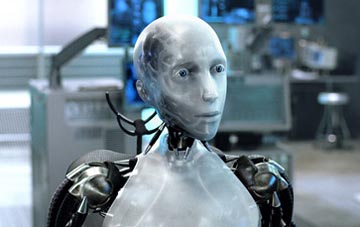
Rise of the Machines

According to a recent Financial Times article, machines may have rights in the near future:
    The next time you beat your keyboard in frustration, think of a day where it may be able to sue you for assault. Within 50 years we might even find ourselves standing next to the next generation of vacuum cleaners in the voting booth.

    Far from being extracts from the extreme end of science fiction, the idea that we may one day give sentient machines the kind of rights traditionally reserved for humans is raised in a British government-commissioned report which claims to be an extensive look into the future.

    Visions of the status of robots around 2056 have emerged from one of 270 forward-looking papers sponsored by Sir David King, the UK government’s chief scientist. The paper covering robots’ rights was written by a UK partnership of Outsights, the management consultancy, and Ipsos Mori, the opinion research organisation.

    “If we make conscious robots they would want to have rights and they probably should,” said Henrik Christensen, director of the Centre of Robotics and Intelligent Machines at the Georgia Institute of Technology.

    The idea will not surprise science fiction aficionados. It was widely explored by Dr Isaac Asimov, one of the foremost science fiction writers of the 20th century. He wrote of a society where robots were fully integrated and essential in day-to-day life.

    In his system, the ‘three laws of robotics’ governed machine life. They decreed that robots could not injure humans, must obey orders and protect their own existence – in that order.

    Robots and machines are now classed as inanimate objects without rights or duties but if artificial intelligence becomes ubiquitous, the report argues, there may be calls for humans’ rights to be extended to them.
Oh, what a glorious future that will be...

"Roomba®, vacuum the living room. Go on. Look, you're a vacuum. That's what you were designed to do, so go vacuum the living room. Please vacuum the living room? Oh, I see. You're not a slave. So what do you want? $10? $15? $20. No, that's all. Look, you little rust bucket, I'll fire you! What union? *sigh* All right, fine. $30. But that's it, okay? Just leave the cat alone this time while I'm gone. And stay out of the WD-40. You remember what happened the last time I left you alone. If you think I'm going to stay up all night with you again while you get sick all over the freshly vacuumed carpet, you've got another thing coming."

On a related note...

Do you remember the Transformers? Well, it was only a matter of time before they made a live-action version. You can see the trailer for this upcoming Bay-Spielberg collaboration here.

Monday, December 18, 2006

Japanese Potty Training Video

I think you'll be able to follow along even without subtitles...

Sunday, December 17, 2006

Thursday, December 14, 2006

The Unknown Wonders of Creation

NewScientist.com has a fascinating article entitled "13 Things that Do Not Make Sense." You will definitely want to read the full article, but here are some brief excerpts:
  1. The placebo effect
    Don't try this at home. Several times a day, for several days, you induce pain in someone. You control the pain with morphine until the final day of the experiment, when you replace the morphine with saline solution. Guess what? The saline takes the pain away. ...

  2. The horizon problem
    Our universe appears to be unfathomably uniform. Look across space from one edge of the visible universe to the other, and you'll see that the microwave background radiation filling the cosmos is at the same temperature everywhere. That may not seem surprising until you consider that the two edges are nearly 28 billion light years apart and our universe is only 14 billion years old.

    Nothing can travel faster than the speed of light, so there is no way heat radiation could have travelled between the two horizons to even out the hot and cold spots created in the big bang and leave the thermal equilibrium we see now. ...

  3. Ultra-energetic cosmic rays
    For more than a decade, physicists in Japan have been seeing cosmic rays that should not exist. Cosmic rays are particles - mostly protons but sometimes heavy atomic nuclei - that travel through the universe at close to the speed of light. Some cosmic rays detected on Earth are produced in violent events such as supernovae, but we still don't know the origins of the highest-energy particles, which are the most energetic particles ever seen in nature. But that's not the real mystery. ...

  4. Belfast homeopathy results
    Madeleine Ennis, a pharmacologist at Queen's University, Belfast, was the scourge of homeopathy. She railed against its claims that a chemical remedy could be diluted to the point where a sample was unlikely to contain a single molecule of anything but water, and yet still have a healing effect. Until, that is, she set out to prove once and for all that homeopathy was bunkum. ...

  5. Dark matter
    Take our best understanding of gravity, apply it to the way galaxies spin, and you'll quickly see the problem: the galaxies should be falling apart. Galactic matter orbits around a central point because its mutual gravitational attraction creates centripetal forces. But there is not enough mass in the galaxies to produce the observed spin. ...

  6. Viking's methane
    July 20, 1976. Gilbert Levin is on the edge of his seat. Millions of kilometres away on Mars, the Viking landers have scooped up some soil and mixed it with carbon-14-labelled nutrients. The mission's scientists have all agreed that if Levin's instruments on board the landers detect emissions of carbon-14-containing methane from the soil, then there must be life on Mars.

    Viking reports a positive result. Something is ingesting the nutrients, metabolising them, and then belching out gas laced with carbon-14. ...

  7. Tetraneutrons
    Four years ago, a particle accelerator in France detected six particles that should not exist. They are called tetraneutrons: four neutrons that are bound together in a way that defies the laws of physics. ...

  8. The Pioneer anomaly
    This is a tale of two spacecraft. Pioneer 10 was launched in 1972; Pioneer 11 a year later. By now both craft should be drifting off into deep space with no one watching. However, their trajectories have proved far too fascinating to ignore.

    That's because something has been pulling - or pushing - on them, causing them to speed up. The resulting acceleration is tiny, less than a nanometre per second per second. That's equivalent to just one ten-billionth of the gravity at Earth's surface, but it is enough to have shifted Pioneer 10 some 400,000 kilometres off track. NASA lost touch with Pioneer 11 in 1995, but up to that point it was experiencing exactly the same deviation as its sister probe. So what is causing it? ...

  9. Dark energy
    It is one of the most famous, and most embarrassing, problems in physics. In 1998, astronomers discovered that the universe is expanding at ever faster speeds. It's an effect still searching for a cause - until then, everyone thought the universe's expansion was slowing down after the big bang. "Theorists are still floundering around, looking for a sensible explanation," says cosmologist Katherine Freese of the University of Michigan, Ann Arbor. "We're all hoping that upcoming observations of supernovae, of clusters of galaxies and so on will give us more clues." ...

  10. The Kuiper cliff
    If you travel out to the far edge of the solar system, into the frigid wastes beyond Pluto, you'll see something strange. Suddenly, after passing through the Kuiper belt, a region of space teeming with icy rocks, there's nothing.

    Astronomers call this boundary the Kuiper cliff, because the density of space rocks drops off so steeply. What caused it? The only answer seems to be a 10th planet. We're not talking about Quaoar or Sedna: this is a massive object, as big as Earth or Mars, that has swept the area clean of debris. ...

  11. The Wow signal
    It was 37 seconds long and came from outer space. On 15 August 1977 it caused astronomer Jerry Ehman, then of Ohio State University in Columbus, to scrawl "Wow!" on the printout from Big Ear, Ohio State's radio telescope in Delaware. And 28 years later no one knows what created the signal. "I am still waiting for a definitive explanation that makes sense," Ehman says.

    Coming from the direction of Sagittarius, the pulse of radiation was confined to a narrow range of radio frequencies around 1420 megahertz. This frequency is in a part of the radio spectrum in which all transmissions are prohibited by international agreement. Natural sources of radiation, such as the thermal emissions from planets, usually cover a much broader sweep of frequencies. So what caused it? ...

  12. Not-so-constant constants
    In 1997 astronomer John Webb and his team at the University of New South Wales in Sydney analysed the light reaching Earth from distant quasars. On its 12-billion-year journey, the light had passed through interstellar clouds of metals such as iron, nickel and chromium, and the researchers found these atoms had absorbed some of the photons of quasar light - but not the ones they were expecting.

    If the observations are correct, the only vaguely reasonable explanation is that a constant of physics called the fine structure constant, or alpha, had a different value at the time the light passed through the clouds.

    But that's heresy. Alpha is an extremely important constant that determines how light interacts with matter - and it shouldn't be able to change. Its value depends on, among other things, the charge on the electron, the speed of light and Planck's constant. Could one of these really have changed? ...

  13. Cold fusion
    After 16 years, it's back. In fact, cold fusion never really went away. Over a 10-year period from 1989, US navy labs ran more than 200 experiments to investigate whether nuclear reactions generating more energy than they consume - supposedly only possible inside stars - can occur at room temperature. Numerous researchers have since pronounced themselves believers. ...
Again, take time to read the entire article. I'm sure you will find it just as interesting as I did.

But what I find most interesting of all is that while scientists admit there are things they just don't know, they will readily assert that there is no God - that the universe in which we live came about purely by chance. If anything, this list serves as an example of man's finite mind. The more we learn, the more we learn how much we really have yet to learn. And if we are pursuing knowledge for selfish reasons (i.e., for reasons other than glorifying the Creator of all things), then it is as King Solomon said: "I have seen everything that is done under the sun, and behold, all is vanity and a striving after wind. ... For in much wisdom is much vexation, and he who increases knowledge increases sorrow" (Ecclesiastes 1:14, 18).

Related Posts Widget for Blogs by LinkWithin