
Showing posts with label Daylight Saving Time. Show all posts
Showing posts with label Daylight Saving Time. Show all posts
Sunday, November 06, 2011
An undeniable truth (11/06/2011)
There isn't a single person who gains an extra hour of sleep when moving the clocks back to standard time. It is merely an excuse to stay up longer.


Saturday, March 12, 2011
Yes, it's that (Daylight Saving) Time again

Unfortunately, many people believe sticking to this archaic ritual is worth all the fuss, if only to enjoy that "extra hour" of sleep come the first Sunday in November. But, as I have been saying for years, DST is actually detrimental to one's health. Consider this report in Time:
"Most people don't have much of a problem — they can adjust their body clock quickly. Eventually, after a couple of days, they already can adapt to the new schedule," says Dr. Xiaoyong Yang, an assistant professor of comparative medicine and cellular and molecular physiology at Yale University, who points out that many people routinely recover from slight shifts in their sleep-wake cycles — after staying up late at night to go to party, for instance. "But for some groups of people — people who have depression or a heart problem — there's some research that suggests that [they] have a higher risk of suicide and heart attack."Now, if you'll excuse me, I have at least a dozen clocks to reset before I turn in.
An Australian study study published in 2008 in Sleep and Biological Rhythms found that men were more likely to commit suicide during the first few weeks of Daylight Saving Time (DST) than at any other time during the year.
Another 2008 study, published by Swedish researchers in the New England Journal of Medicine, found that the number of serious heart attacks jumps 6% to 10% on the first three workdays after DST begins.
In other words, people who are already vulnerable to certain health problems may experience more severe effects of their body-clock disruption. Why that's so is still unclear, but Yang theorizes that shifts in biologic rhythms could trigger harmful inflammatory or metabolic changes at the cellular level, which these individuals may be more susceptible to.
Tuesday, March 18, 2008
Another Reason to Hate Daylight Saving Time
I was out of town on the weekend of the "Big Change." As usual, I set the alarm on my cell phone to rouse me in the a.m. Since I'm not a very trusting person, I also set the hotel's bedside alarm clock as a back-up.
Not surprisingly, it was the alarm clock that woke me.
Since I am a very inquisitive person, I scrolled through the settings on my cell phone to see what went wrong. Had the clock reset to Central Daylight Time? Yes. Was the alarm on? Yes. Was it set for the correct time? Aha! It was off by (yes, you guessed it) one hour: 7:00 instead of 6:00.
Now, I have seen cell phone clocks fail to adjust automatically to coincide with this idiotic time-shift, but for the time of the alarm to jump ahead? There was a distinct possibility that I could have ended up oversleeping by two whole hours!
Pretty clever, daylight saving time. You almost got me. Pardon the expression, but you'll have to get up pretty early to fool me. I won't rest until I put you out of my misery once and for all.
Not surprisingly, it was the alarm clock that woke me.
Since I am a very inquisitive person, I scrolled through the settings on my cell phone to see what went wrong. Had the clock reset to Central Daylight Time? Yes. Was the alarm on? Yes. Was it set for the correct time? Aha! It was off by (yes, you guessed it) one hour: 7:00 instead of 6:00.
Now, I have seen cell phone clocks fail to adjust automatically to coincide with this idiotic time-shift, but for the time of the alarm to jump ahead? There was a distinct possibility that I could have ended up oversleeping by two whole hours!
Pretty clever, daylight saving time. You almost got me. Pardon the expression, but you'll have to get up pretty early to fool me. I won't rest until I put you out of my misery once and for all.
Wednesday, February 27, 2008
End Daylight-Saving Time Now!
I've been telling you all along that daylight-saving time is an idiotic exercise in futility. A recent study backs me up:
For decades, conventional wisdom has held that daylight-saving time, which begins March 9, reduces energy use. But a unique situation in Indiana provides evidence challenging that view: Springing forward may actually waste energy.It's time we ended this daylight-saving nonsense once and for all.
Up until two years ago, only 15 of Indiana's 92 counties set their clocks an hour ahead in the spring and an hour back in the fall. The rest stayed on standard time all year, in part because farmers resisted the prospect of having to work an extra hour in the morning dark. But many residents came to hate falling in and out of sync with businesses and residents in neighboring states and prevailed upon the Indiana Legislature to put the entire state on daylight-saving time beginning in the spring of 2006.
Indiana's change of heart gave University of California-Santa Barbara economics professor Matthew Kotchen and Ph.D. student Laura Grant a unique way to see how the time shift affects energy use. Using more than seven million monthly meter readings from Duke Energy Corp., covering nearly all the households in southern Indiana for three years, they were able to compare energy consumption before and after counties began observing daylight-saving time. Readings from counties that had already adopted daylight-saving time provided a control group that helped them to adjust for changes in weather from one year to the next.
Their finding: Having the entire state switch to daylight-saving time each year, rather than stay on standard time, costs Indiana households an additional $8.6 million in electricity bills. They conclude that the reduced cost of lighting in afternoons during daylight-saving time is more than offset by the higher air-conditioning costs on hot afternoons and increased heating costs on cool mornings.
"I've never had a paper with such a clear and unambiguous finding as this," says Mr. Kotchen, who presented the paper at a National Bureau of Economic Research conference this month.
Monday, October 30, 2006
What Time Is It?
In case you were wondering, Daylight Saving (not Savings) Time just ended. We are now on Standard Time.
Chris's last post got me thinking. Why in the world do we observe Daylight Saving Time?
Here's a brief history, courtesy of Wikipedia:
 I'm sorry, but DST is a burden, a nuisance, a pain. Changing all those clocks and other electronic gadgets - no to mention the added pressure of remembering to switch out the smoke detector batteries - is a chore, and there always seems to be one clock that's forgotten. For me, it's the clock in the car.
With all the fuss that's made about this seasonal ritual, perhaps we should just go ahead and make it an official holiday. Seriously. We already have Halloween greeting cards, for crying out loud!
If you really want to know what time it is, I'll tell you: It's time to end this stupid ritual. I'm sorry, but I just don't buy the "energy conservation" argument that's based on studies done in the '70s. We live in an age of televisions, computers, and fax machines, most of which are running 24/7, regardless of how dark or light it is outside. And in addition to the havoc wreaked on our regular clocks, we come to find out that DST messes with our "circadian clocks."
Now, if someone were to suggest shutting down the government as part of Daylight Saving Time in an effort to save energy, then I would probably have to reconsider my position on the issue. At least that way they would have less time to come up with ridiculous ideas.
Chris's last post got me thinking. Why in the world do we observe Daylight Saving Time?
Here's a brief history, courtesy of Wikipedia:
- The idea of DST was first put into practice by the German government during the First World War, between April 30, 1916 and October 1, 1916. Shortly afterward, the United Kingdom followed suit, first adopting it between May 21 and October 1, 1916. On June 17, 1917 Newfoundland became the first North American jurisdiction to adopt DST with the passing of the Daylight Saving Act of 1917. On March 19, 1918, the U.S. Congress established several time zones, which had been in use by railroads and most cities since 1883 and made DST official, effective March 31, for the remainder of World War I. It was observed for seven months in 1918 and 1919. The law, however, proved so unpopular, mostly because people rose and went to bed earlier than in current times, that it was repealed in 1919, when Congress overrode President Woodrow Wilson's veto of the repeal. ...
... DST was reinstated in the United States on February 9, 1942, again as a wartime measure to conserve resources. This remained in effect until World War II began winding down and the requirement was removed on September 30, 1945. During this period, the official designation "War Time" was used for year-round DST. The year-round War Time was double daylight saving time without reverting back to standard time during the winter months. When entering double daylight saving time, clocks are advanced two hours instead of one hour. ...
... One of the major reasons given for observing DST is energy conservation. Theoretically, the amount of residential electricity needed in the evening hours is dependent both on when the sun sets and when people go to bed. Because people tend to observe the same bedtime year-round, by artificially moving sunset one hour later, the amount of energy used is theoretically reduced. A 1975 United States Department of Transportation study showed that DST would theoretically reduce the country's electricity usage by 1% from March to April, if implemented during these months.
 I'm sorry, but DST is a burden, a nuisance, a pain. Changing all those clocks and other electronic gadgets - no to mention the added pressure of remembering to switch out the smoke detector batteries - is a chore, and there always seems to be one clock that's forgotten. For me, it's the clock in the car.
With all the fuss that's made about this seasonal ritual, perhaps we should just go ahead and make it an official holiday. Seriously. We already have Halloween greeting cards, for crying out loud!
If you really want to know what time it is, I'll tell you: It's time to end this stupid ritual. I'm sorry, but I just don't buy the "energy conservation" argument that's based on studies done in the '70s. We live in an age of televisions, computers, and fax machines, most of which are running 24/7, regardless of how dark or light it is outside. And in addition to the havoc wreaked on our regular clocks, we come to find out that DST messes with our "circadian clocks."
Now, if someone were to suggest shutting down the government as part of Daylight Saving Time in an effort to save energy, then I would probably have to reconsider my position on the issue. At least that way they would have less time to come up with ridiculous ideas.
Sunday, October 29, 2006
Digital Clocks
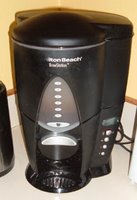
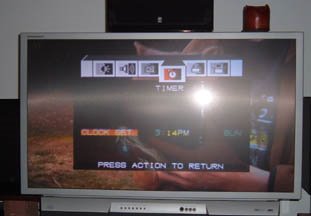
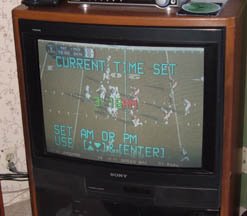
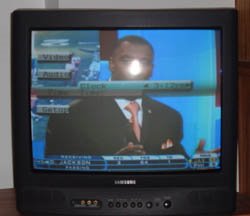
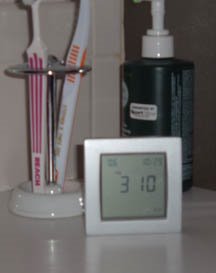
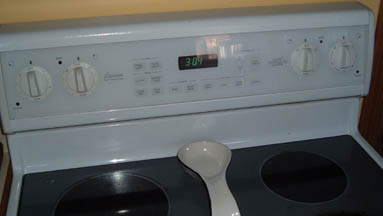
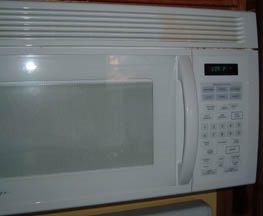
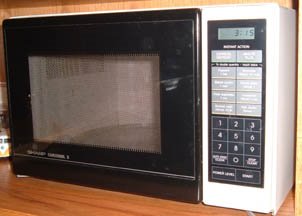
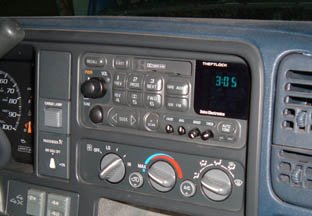
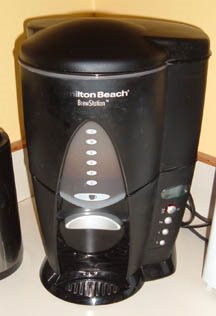
Ah...daylight/standard time changes. Don't you love wandering around the house looking for all the clocks? My beef is digital clocks. No one of them is set in the same way! Here's the household devices with digital clocks I set this afternoon:
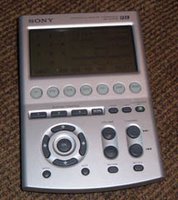
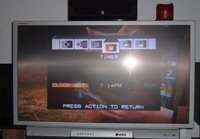
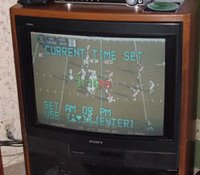
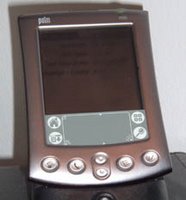
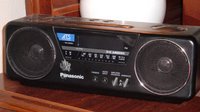
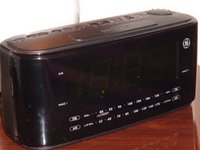
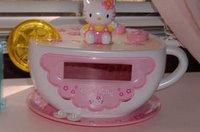
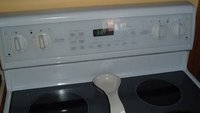
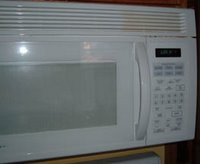
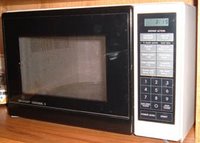
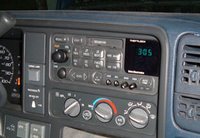

Oh, and not to forget the clock in the camera I used to take all these snapshots:

Not pictured above are all the analog clocks and the automatic digital clocks! Thankfully, our VCR, satellite boxes, cell phones, and computers all set themselves now (usually). Still, I probably spend a cumulative half hour just figuring out the procedure for setting each different digital clock. I can never remember each one's individual quirks from six months ago. And I'm supposed to have a knack for this kind of thing! I think we need a consumer electronics standard that forces all digital clocks to have the same set of buttons and standard operating procedure.
Now I get to look forward to repeating this at work tomorrow morning: correcting all the problems caused by system clocks that didn't reset, or did so improperly.
Oh, and while I'm dispensing advice...replace the batteries in your smoke and Carbon Monoxide alarms! That's the best way to remember to stay on top of those...just do it every time you change your clocks. The TV station I work at covers too many sad stories every winter about fatalities caused by a lack of working smoke and CO alarms! Ummm...OK...I need to log off now and run to the store for 9v batteries.




Oh, and not to forget the clock in the camera I used to take all these snapshots:

Not pictured above are all the analog clocks and the automatic digital clocks! Thankfully, our VCR, satellite boxes, cell phones, and computers all set themselves now (usually). Still, I probably spend a cumulative half hour just figuring out the procedure for setting each different digital clock. I can never remember each one's individual quirks from six months ago. And I'm supposed to have a knack for this kind of thing! I think we need a consumer electronics standard that forces all digital clocks to have the same set of buttons and standard operating procedure.
Now I get to look forward to repeating this at work tomorrow morning: correcting all the problems caused by system clocks that didn't reset, or did so improperly.
Oh, and while I'm dispensing advice...replace the batteries in your smoke and Carbon Monoxide alarms! That's the best way to remember to stay on top of those...just do it every time you change your clocks. The TV station I work at covers too many sad stories every winter about fatalities caused by a lack of working smoke and CO alarms! Ummm...OK...I need to log off now and run to the store for 9v batteries.
Subscribe to:
Posts (Atom)

